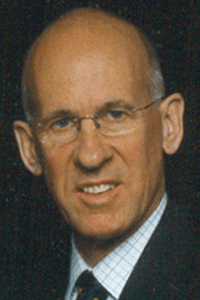
Ron Meyers
Ron Meyers is an international lecturer who served 9 years in the US, 5 in Canada, 13 in Korea, and 5 in China before becoming a Professor at Oral Roberts University and lecturing in 19 more nations. He has a PhD in Intercultural Studies. Ron is author of Habits of Highly Effective Christians.
Contact Soar with Eagles for more information on Ron at 479.903.0208 or carrie@soarhigher.com
Ron’s book is available in the online bookstore.
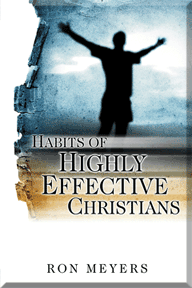
Ron Meyers’ book, Habits of Highly Effective Christians, reveals 17 habits that will enrich our lives and increase our usefulness. It provides solid principles for creating an effective and abundant life.
Click here to read more about it.
$18.95
Two, how we start the race is not nearly as significant as how we finish it. At age 55, I ran my first marathon. I have run 29 more since then. In each race throughout the first 10 or so miles, I am usually passed by person after person. My third race was the Andy Payne Memorial Marathon — three times around Lake Overholser just west of Oklahoma City. The race began in a drizzling rain at 6:30 a.m. and ended in the heat of a sunny Oklahoma morning in May. At Mile 20, I began to count the people that passed me and how many I passed. To my surprise, no one passed me, and I passed 21 runners, most of whom were younger than I! Have you ever heard that a marathon race begins at Mile 20?
I can well remember reflecting on the importance of the finish of the race, saying to myself during those last six and two-tenths miles as I passed those other runners, “The reason that I train is so I can do this.” I stopped feeling apologetic every time I passed someone and began to enjoy passing other runners — winning late in the race — in spite of the pain. I placed second in my age group with my best time until then. A year later, I won first place in my age group in that same marathon. After running 3 hours and 40 minutes, I passed the man who won second place in the last 200 yards! I admit it is disheartening to be passed by so many during the earlier part of the race, but even with a tired body and aching muscles, there is joy in my heart to finish well. Our race in life as growing Christians is much like that. If we learn to endure, we can finish well, even if we didn’t start well.
When in Bible College, I had a gifted, prayerful, and zealous classmate. My wife, Char, and I knew him and his wife well. Char and his wife had been friends since childhood and during Bible college years. Char even traveled to youth camp one summer singing and ministering with them. Later, during our first years in Korea, Char and I worked under his supervision. He was intellectually talented, and there were numerous times his verbal and people skills impressed me. Nevertheless, years later and some years ago now, he divorced his wife and not too long after that married a wealthy lady 30 years older than himself. He did not leave his wife to marry the wealthy lady. However, having divorced and then married one so much older than himself negatively affects his influence as an exemplary Christian leader. I grieve to think of his lost potential for meaningful Christian service. Receiving God-given material blessings is fine, but to manipulate circumstances in the pursuit of financial goals does not position him to finish well. He sprinted well earlier in the race — if only he were still pressing on to finish well.
On the other hand, most of us have observed some senior and seasoned believers doing very well, maturing further and further with strong spirits even late in life. To listen to such mature yet growing veterans is a joy; they speak from many years of continual growth with rich experience. We rejoice that they have not stopped growing, and their examples encourage us to finish well, too.
There are many people that seem to have advantages over us at the beginning of our races. We all can think of examples. My cousins had advantages I wished I had: better educations, more financial resources, better connections and, it seemed, more native talent. Never mind. If we set our minds to finish well, we will view our life experiences as learning opportunities and run better and better as the years go by.
Long-term development and service flows out of who we are. We must maintain integrity and spirituality if long-range good is to flow out from us. Development that has peaked, ceased growing, or is set aside — disciplined by God — usually can be traced back to problems in spirituality. We must not stop growing inwardly. It’s the finish that counts. Be patient with yourself. The increase of our spiritual influence is a long process. Understanding God’s developmental process assumes that, throughout a lifetime, a Christian continues to increase in godly influence and experiences God’s continued involvement in his growth.
My father was a pastor who had a vision for opening new churches. At various times throughout my junior and senior high school days, we would travel to nearby towns and paint and repair roofs on old church buildings. Then Dad would find someone with a pastor’s heart to serve in that church. Dad’s “hobby” had no income and considerable expenses. To finance this, he would brush-paint houses and buildings in our hometown and the neighboring countryside. Dad and I, as I look back on it now, spent literally hundreds of hours painting, working, and talking together during those years. During the school year, I would help paint after I was through carrying papers on weekdays and then on Saturdays too. During the summer, I would paint until it was time for me to go to the newspaper office.
At the time, I thought my cousins had advantages. Now I realize that I had another set of advantages. I learned to work without allowing myself to be distracted. I learned that no sacrifice was too great to help build God’s kingdom. I learned that serving God brought greater satisfaction and certainly more hope of reward in heaven than material gain. I learned to push myself, and my body and arms grew strong. I learned how to carry a ladder extended 40 feet into the air. I learned how to be safe in potentially dangerous places. I learned to deal with working in high places, how to remain composed on the top of a 40-foot ladder when wasps did not welcome me in the vicinity of their home. I learned how to calmly destroy the whole nest without jumping off. Through these experiences, I learned to focus and how to stay focused. I learned the value of work. And I learned the value of laughter and rest. There is, of course, another set of possible lessons that could be learned by economically privileged persons like my cousins. The point is not that you need difficulties or disadvantages in order to learn, but that you need a teachable attitude so you learn from whatever circumstances or experiences come your way.
Two further benefits give me cause to appreciate what happened in those years. One is that I experienced no distance between my father and myself. We remained friends throughout those years. He called me “pal” until he died. Upon reflection, I now know why I sometimes call my sons that. Secondly, he passed on to me the ability to value “things above.” The work ethic and spiritual values that I “inherited” from my dad during those years helped me work my way through Bible College and to hold steady through many fulfilling years of ministry.
Some people do not appreciate the kingdom-related values Dad passed on to me, and this is their loss and my regret. In some vocations, supervisors help monitor our activities so we keep working. But the ability to focus and monitor ourselves is something experience produces. How blessed I am to have learned how to do that during my high school years, painting houses, barns, and church buildings.
In the development of our potential, our growth process is more like a marathon than a sprint. What one thinks about, how one concentrates, how one remains focused and how one avoids listening to certain voices (aching muscles) all go into the hours of training for and running a marathon. In a sprint, it all happens much faster and is over in a moment. In the long process of our life-long race, it helps if we learn to appreciate the adventure as it unfolds. The process of Christian development entails adventure, suspense, waiting, expectation, surprises, growth, set-backs, and victories. One of the keys is to realize it is a process and settle in for the long haul.